
From Rule-Writing to
Rule-Power in the
Indo-Pacific
Regulatory competition in the Indo-Pacific’s Weaponized Economy
By Dr. Koen Berden
A decade ago, regulatory competition in the Indo-Pacific was largely a contest over who would write the rules of trade. Since then, the expected United States (U.S.)-led hierarchy has become a multipolar patchwork (see Figure 1). The Comprehensive and Progressive Agreement for Trans-Pacific Partnership (CPTPP) supplies high-standard rules, while the Regional Comprehensive Economic Partnership (RCEP) brings scale. The European Union (EU) exports deep regulation through bilateral agreements, and the U.S. increasingly operates outside traditional comprehensive trade agreements. The next phase in regulatory competition is less about writing rules than determining who wields power with those rules. Now, the key focus is on who can use access to markets, technology, finance, data and critical inputs to shape the regulatory choices that others make.
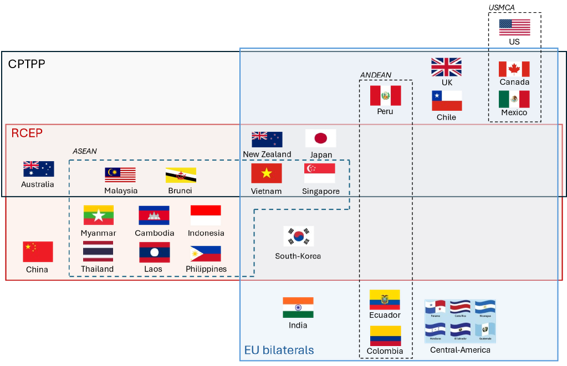
Figure 1: CPTPP, RCEP and EU bilateral Free Trade Agreements in 2026 - Source: Berden (2026)
The dynamic that prioritizes power is the key concept of the weaponized economy: asymmetric economic networks give rise to chokepoints countries can exploit for strategic purposes. In the Indo-Pacific, this framework already extends beyond finance. Export controls, investment screening, tariffs, subsidies, local-content requirements, data rules, and critical-mineral policies increasingly sit at the intersection of trade policy and national security. Regulation still reduces transaction costs and creates trust, but it now also restricts access, redirects supply chains, and imposes geopolitical costs.
Weaponized Economies, Across the Globe
The state of affairs in the U.S. most clearly illustrates the shift. The country’s withdrawal from the Trans-Pacific Partnership (TPP) in 2017 reduced its ability to write region-wide trade rules through a mega-Free Trade Agreement (FTA) and with it its regulatory power. Instead, Washington increasingly projects influence through control over strategic technologies and market access. In January, for example, the U.S. imposed a 25 percent Section 232 tariff on a narrow category of advanced computing chips while explicitly linking semiconductor imports to national security and domestic production. Its February trade framework with India also connected market access with export controls, inbound and outbound investment reviews, supply-chain resilience, and digital trade rules. The U.S. model is, therefore, becoming less trade-focused and increasingly security-centered.
China’s model relies on manufacturing scale, supply-chain centrality, and growing regulatory reach. RCEP, an Asia-focused FTA that includes China, remains a relatively shallow trade deal in several non-tariff areas. Even so, its common rules of origin reinforce Asian production networks in which China is core. Beijing can also exercise leverage through critical inputs. In April 2025, China introduced export controls on several rare-earth elements (REE) on national-security and non-proliferation grounds. Whatever the stated rationale, the episode underlined a structural reality: Regulatory authority over indispensable inputs can become geopolitical leverage.
The EU offers a third model. Its comparative advantage is deep regulation: product standards, sustainability requirements, competition rules, data governance, and regulatory cooperation backed by access to the single market. The EU’s Indo-Pacific network has thickened significantly over the past decade. Negotiations on the EU-India FTA concluded in January, while the EU-Singapore Digital Trade Agreement entered into force on February 1. Europe is also moving into economic-security instruments: Its strengthened FDI-screening framework now extends to all EU Member States (EUMS) and covers strategic technologies, critical raw materials, and infrastructure. The distinction between “Brussels Effect” regulation, or the global impact of EU regulations, and geoeconomic statecraft is narrowing.
This leaves the Indo-Pacific’s middle powers in a more important position than the term suggests: Japan helped rescue TPP after the U.S. withdrawal by rebranding it as the CPTPP; Singapore has become a laboratory for interoperable digital rules; Vietnam is becoming an increasingly strong production powerhouse for Asia, the EU, and U.S. with compatible manufacturing rules; India, meanwhile, resists choosing a single regulatory camp and instead bargains across them. The Association of Southeast Asian Nations’ (ASEAN) concluded Digital Economy Framework Agreement (DEFA) adds another indigenous rule-making platform. These actors are not simply rule-takers. They function as swing states and bridges between regulatory systems.
Smarter Regulations as a Strategic Advantage
Given these dynamics in the Indo-Pacific, the EU and the U.S. should stop treating regulatory leadership as a competition. Neither can dominate the Indo-Pacific rulebook, and attempts to force alignment risks accelerating hedging. They should instead work with Japan, Australia, Singapore, India, South-Korea, and ASEAN – the Indo-Pacific’s regulatory swing states – on interoperable rules in areas where weaponization risks are highest: semiconductors, critical minerals, AI, data, export controls, and investment screening.
The objective should not be identical regulation. It should be trusted compatibility, transparent security exceptions and consultation before measures create major spillovers for partners via bilateral and/or regional partnerships and agreements. This also means exploring the cumulation of preferences across bilateral trade partners for the EU, allowing one EU trade partner to benefit from an EU trade agreement with another EU trade partner. The result would be more competition between EU, U.S., and Chinese regulatory frameworks in the Indo-Pacific and various Asian economies switching between systems depending on the trade partner; and thus differentiated trade patterns between economies in the Indo-Pacific and its global partners.
In 2016, the prize was writing the region’s rules. In 2026, the greater prize is shaping the interfaces between competing rulebooks while preventing economic security from becoming economic fragmentation. In a weaponized economy, regulatory leadership will belong not to the power that writes the most rules, but to the coalition that makes its rules the easiest and safest for others adopt.
Dr. Koen Berden, is a 2026 Fellow of the Bertelsmann Foundation and Managing Director of Trade Impact B.V.