Spectacle and Speculation: Trump and Xi Leave More Questions than Answers
By Marshall Reid
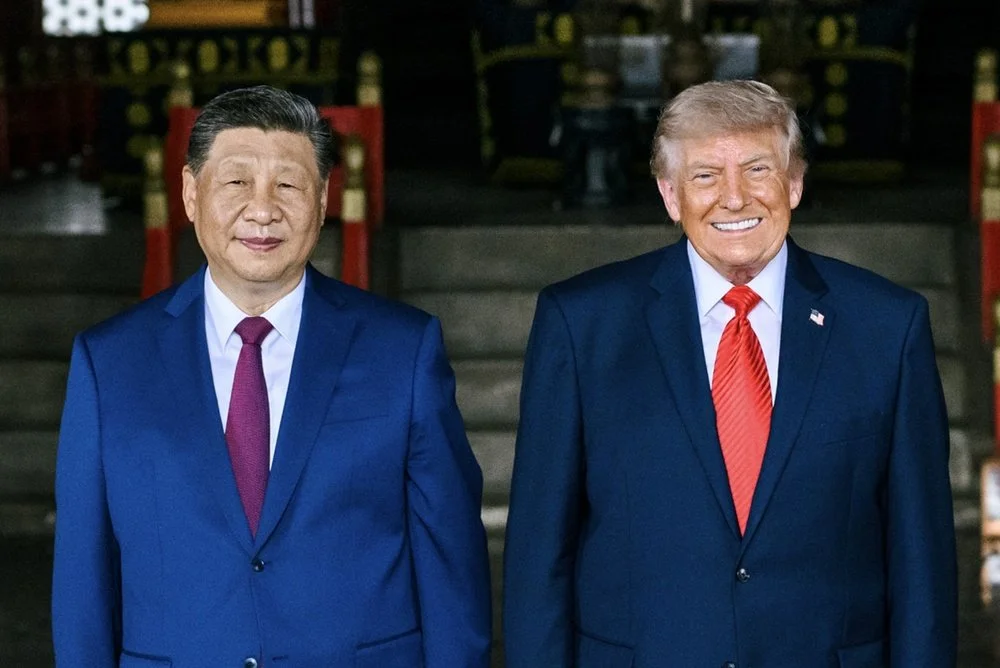
In the Trump White House, optics are everything. A veteran of countless primetime television programs, the president understands more than most the power of a perfect shot. In the right hands, spectacle can have a substance of its own. Trump brought that flair for the dramatic to last month’s high-stakes summit with Chinese leader Xi Jinping in Washington, D.C. Troops marched in formation, bombers thundered overhead and a coterie of tech CEOs joined for dinner.
As the dust has settled and details have surfaced, however, the products of Trump’s pageantry appear to be modest. The two sides managed to secure a two-month extension on the trade truce negotiated last year in Busan, South Korea, as well as an agreement to reduce tariffs on $60 billion in goods. But on a variety of other issues, including AI and Taiwan, the two superpowers remain at loggerheads.
Cool War
The U.S.-China rivalry is hardly a new phenomenon. As China has ascended from agrarian outsider to industrial behemoth, its relationship with the United States has grown increasingly antagonistic. In describing the complex interplay between the two powers, Xi often invokes the concept of the Thucydides Trap—the historic observation that rising powers frequently come into conflict with older, more established hegemons.
Since returning to office last year, Donald Trump has done little to avoid this trap in his dealings with Beijing. With trademark unpredictability, the president has veered from confrontation to congeniality. In early 2025, he imposed a raft of tariffs on China, reigniting the trade war from his first term and kicking off a brief period of retaliatory one-upmanship. By April of that year, U.S. tariffs on Chinese exports had reached 135 percent, while Chinese tariffs on U.S. exports had surged to over 145 percent.
In the months that have followed, however, the relationship has slowly restabilized. Tariff rates have fallen precipitously, while rhetoric has mostly returned to pre-crisis politeness. In May of 2026, Trump made a highly publicized visit to Beijing, where he was met with a dazzling and carefully choreographed welcome display. The president spent much of his visit praising Xi for his warmth and hospitality—a far cry from the animosity of 2025.
Despite the apparent camaraderie between Trump and Xi, the two leaders entered their September summit amid considerable uncertainty. Beijing’s support for Iran and Russia has infuriated many on Capitol Hill, while Chinese industrial policy continues to put pressure on U.S. manufacturing. Rising tensions over AI, semiconductors and critical minerals have further strained relations. Taiwan, as ever, remains a sticking point.
High Pressure, Low Impact
In the lead-up to last week’s summit, most experts predicted the meeting would be full of spectacle, amiable rhetoric and little else. Such projections proved largely accurate.
Following Trump’s unprecedented display of hospitality in personally welcoming Xi at Joint Base Andrews came a demonstration of U.S. military might, complete with soldiers wearing tricornered hats and flyovers by B-1B bombers. Opening remarks by both leaders pledged collaboration to address pressing issues, and the personal relationship between Trump and Xi appeared friendly and respectful.
Once the pomp and circumstance came to an end, however, true negotiations began. While the exact details of the discussion remain unclear, readouts released by both sides in the days since depict a meeting that was heavy on rhetoric and light on deliverables—aside from Xi’s headline-making announcement that U.S. zoos would receive several Chinese pandas and 100,000 U.S. students would be invited to study or work in China.
On the economic side, the two agreed on a patchwork of smaller deals seemingly aimed at maintaining the status quo rather than making meaningful progress. The extension of last year’s trade truce was a welcome, albeit expected development. Had the agreement lapsed as scheduled on November 10, the U.S. could have potentially lost access to many Chinese critical minerals. Nevertheless, the short duration of the extension and the apparent lack of progress on a more substantive critical minerals agreement is concerning.
Other deals mentioned in the fact sheets included the aforementioned accord to reduce tariffs on around $60 billion in goods, as well as a Chinese agreement to “import at least 10 million metric tons of coal from the United States in 2027 and again 2028.” The two also made progress on Trump’s flagship Board of Trade and Board of Investment initiatives, though precise details remain somewhat unclear.
The results of the summit were even more modest for issues outside economics. According to the readouts, the two sides engaged in discussions on AI, narcotics, the war in Iran and Taiwan. In all four instances, the leaders largely held firm to preexisting stances and pledged to continue dialogue in the future. Notably, neither readout mentions any talk of an outstanding $14 billion arms sale to Taiwan that has been on hold since Trump’s visit to Beijing in May.
Eye of the Beholder
For observers in Washington, Beijing, and beyond, the Trump-Xi summit has already become something of a Rorschach test. Some have hailed it as a triumph of personal diplomacy, arguing that the clear friendliness between the two leaders will pave the way for a more lasting détente. Others have condemned it as further proof of Trump’s naïve and superficial approach to foreign policy. Even among Trump’s Republican supporters, the meeting has engendered polarized reactions. While some have praised the president’s ability to engage with difficult adversaries, many others have expressed frustration with his perceived chumminess with foreign autocrats.
Ultimately, the meeting seems unlikely to produce significant long-term impacts. Both Trump and Xi are facing challenging domestic circumstances, potentially complicating efforts to build on any momentum from the summit. Current polling suggests that the 2026 U.S. midterm elections will result in major Republican losses, which could, in turn, substantially reduce Trump’s room for maneuver. While Xi’s position is considerably less vulnerable, the Chinese leader must balance a busy calendar of international engagements with a host of domestic challenges, including a slowing economy and complex Communist Party politics.
Though the summit represented a welcome contrast to the spiraling economic warfare of early 2025, its lack of substance was frustratingly emblematic of modern U.S.-China relations. In an era defined by mounting geopolitical and technological challenges, the globe’s two superpowers continue to prioritize vague rhetoric over substantive negotiation. External observers, from Europe to Taiwan, are sorely in need of clarity and consistency. If this meeting was any indication, these states will need to keep waiting.