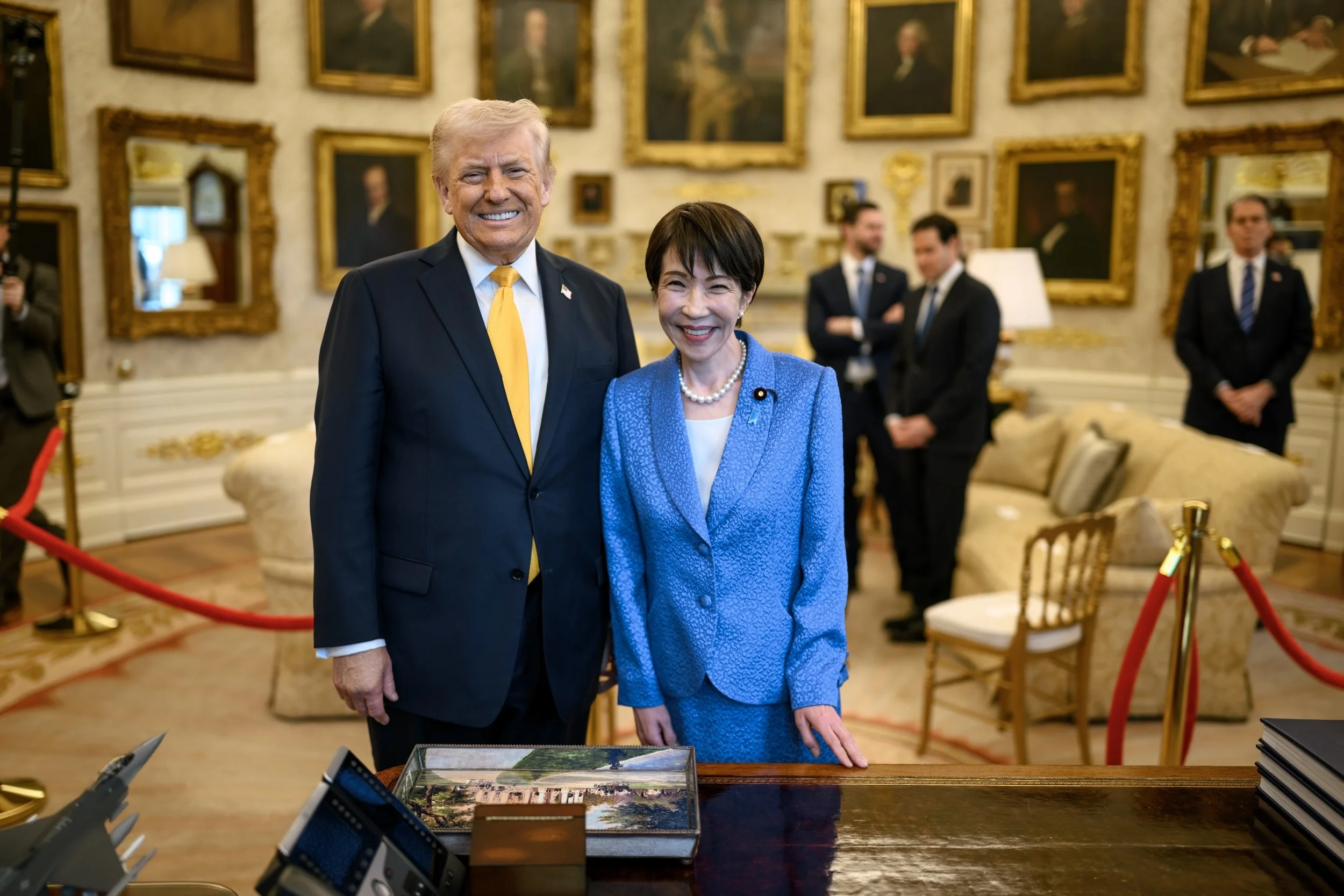
Walking the Tightrope: Takaichi Survives Second Trump Summit
By Marshall Reid
For Japanese Prime Minister Sanae Takaichi, 2026 has already been a roller coaster. As recently as February, the nation’s first female leader seemed untouchable. The Liberal Democratic Party (LDP), reduced to a shadow of itself in 2025 amid economic stagnation and multiple corruption scandals, experienced a remarkable resurgence under her leadership in the February parliamentary elections. Armed with an unprecedented legislative majority and riding a wave of popular support, Takaichi hoped to continue her string of successes with a productive meeting with U.S. President Donald Trump in Washington, DC. However, these hopes were dampened in the weeks leading up to the summit, as the expanding war in the Middle East relegated U.S.-Japan relations to the backburner.
While hardly the disaster that some observers feared, the March 19 summit at the White House was considerably less consequential than initially envisioned. Takaichi was unsuccessful in her efforts to gain U.S. support against Chinese pressure, a key priority for her in the lead-up to the meeting. With the conflagration in Iran consuming the bulk of Trump’s attention, the prime minister instead settled for a more modest agenda: survive. By this standard, Takaichi was undoubtedly successful. Nevertheless, significant questions about the future of the U.S.-Japan alliance remain.
High Hopes
When the meeting between the two leaders was first announced in early February, the Trump-Takaichi summit was quickly highlighted as a major event on the diplomatic calendar. The Japanese prime minister had exceeded expectations during her first encounter with Trump in Tokyo in October 2025, and hoped to build on that momentum. These ambitions only grew following her landslide victory in the parliamentary elections. Wielding more political capital than almost any Japanese leader before her, Takaichi seemed well-positioned to negotiate with her unpredictable U.S. counterpart.
For Takaichi, the stakes of the summit were high. Soon after taking office in October, the prime minister courted controversy when she said that a Chinese attack on Taiwan would constitute an “existential threat” for Japan. These remarks were quickly condemned by the PRC, which retaliated by imposing a series of economic and diplomatic restrictions on Japan. Such saber-rattling intensified feelings of insecurity in Tokyo, which now faces threats on multiple fronts. Accordingly, Takaichi reportedly hoped to use the March 19 meeting at the White House to reinforce U.S. security commitments to Japan, particularly because Trump is slated to meet with Chinese leader Xi Jinping later this year.
Unfortunately for the prime minister, events in the Middle East once again redirected U.S. attention. On February 28, the U.S. and Israel launched coordinated attacks on Iran, kicking off a conflict that has rapidly grown in scale and intensity. Almost immediately, the Trump-Takaichi summit became something of an afterthought.
Modest Results
The war in Iran fundamentally altered the terms of the meeting. In the wake of Iranian attacks on merchant vessels in and around the Strait of Hormuz, Trump has repeatedly called on allies, including Japan, to help secure the waterway. These demands have caused considerable consternation in Japan, which is constitutionally prohibited from engaging in offensive warfare. For Takaichi and her team, the summit with Trump suddenly looked far more perilous. If the prime minister were to fail in her efforts to mollify the president, she risked a humiliating dressing down in the Oval Office, a fate that befell Ukrainian President Volodymyr Zelenskyy in 2025.
Considering these challenges, Takaichi was largely successful. She continued her strategy from their first meeting, flattering Trump and praising his geopolitical instincts. Even as the president veered into tasteless jokes – Trump pointed to Japan’s 1941 attack on Pearl Harbor, noting that that Japan failed to warn the US of its imminent attack– Takaichi remained calm and measured. In her remarks, she highlighted the many similarities between the U.S. and Japan while omitting any disagreements. And while she was unable to secure U.S. commitments to Japan’s defense, she seems to have assuaged Trump regarding Japanese involvement in the Middle East. Takaichi also promised up to $73 billion in Japanese investment in the U.S., a commitment that clearly pleased Trump. Her performance received strong initial feedback from the Japanese public, with Yomiuri Shimbun reporting that 69% of respondents approved of her conduct in the meeting.
What Next?
For Takaichi, the summit with Trump will undoubtedly be seen as a victory. Using skillful diplomacy and no small amount of charm, the prime minister successfully avoided a disastrous Oval Office confrontation, while achieving many of her key objectives. However, the U.S.-Japan relationship remains on shaky ground. Trump has little enthusiasm for traditional alliances, and his transactional tendencies have already placed considerable strain on the partnership. The ongoing conflict in Iran is unlikely to improve matters. Though Takaichi appears to have satisfied Trump for now, he is almost certain to renew his pressure on Tokyo to contribute to the U.S. efforts in the Middle East.
As the White House summit made clear, Takaichi is more than capable of holding her own against Trump. However, with China pressing on Japan’s periphery and increasing global volatility, Japan cannot afford to merely maintain the status quo. For her part, Takaichi clearly understands this. She has already conducted outreach to many other allies and partners, announced significant increases in defense spending and initiated an effort to use her legislative majority to implement long-rumored revisions to Japan’s constitution. With a high-risk meeting with Trump behind her, Takaichi seems poised to pursue a more proactive, independent foreign policy, even as the U.S.-Japan alliance enters a more uncertain era.